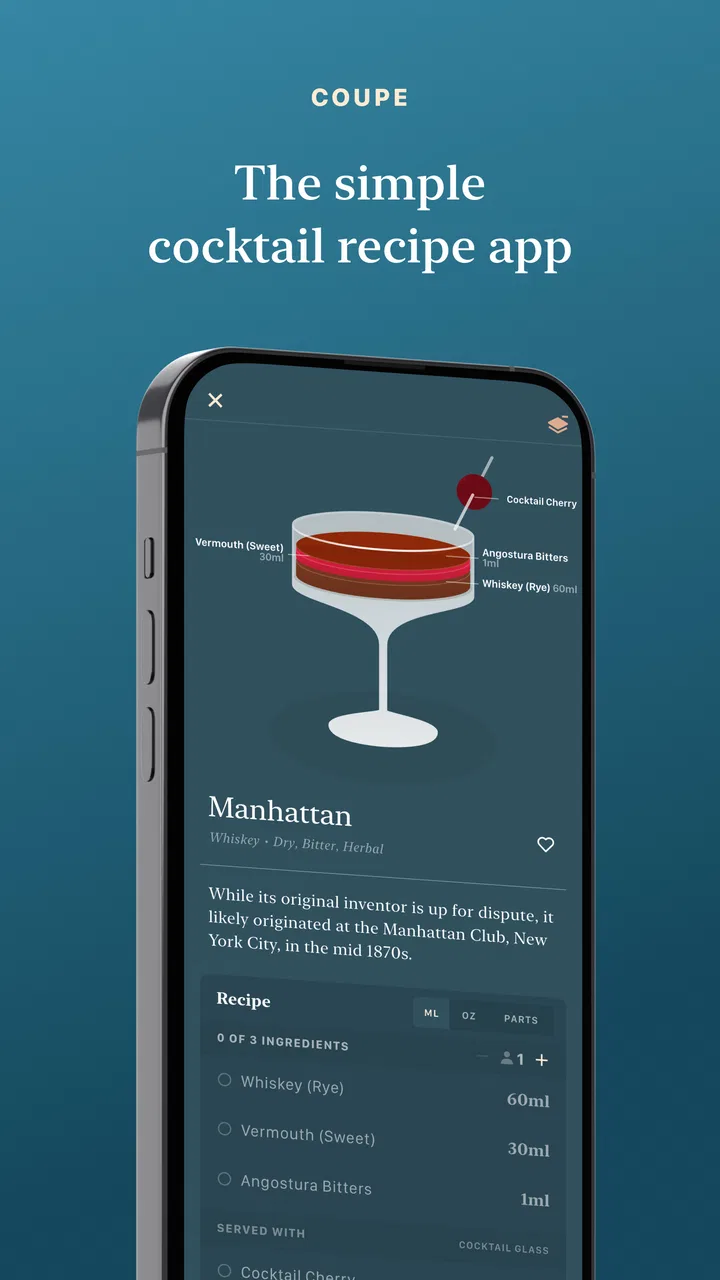
Coupe - cocktail recipes
- 4.6
- Rating
- 10.00K
- Installs
- Free
- Price

 Analysis by App-foxy
I approached Coupe as the kind of app I would open when I wanted to make a better drink at home without sorting through a noisy collection of random recipes. It is a free Food & Drink app from Studio Kamay, aimed at people who already have some interest in cocktails and want a more considered recipe-book experience. The focus feels narrower than a general cooking app, and that is important: this is not trying to be a complete kitchen reference for every meal or beverage.
After spending time with it, my view is fairly simple. Coupe is most appealing when you care about choosing a cocktail thoughtfully, preparing it with attention, and keeping a small home bar useful rather than buying ingredients for one impulsive recipe. It is less convincing for someone who wants a huge searchable database, automatic shopping support, or a casual list of quick mixed drinks. The app’s strength is its curated character, but that same focus can feel limiting depending on how you normally choose a drink.
How I would decide whether Coupe fits my bar
The first question is not whether you like cocktails. It is how you look for them. If I am hosting a quiet evening and want to choose one drink that suits the mood, a selective recipe book makes sense. If I am standing in a shop with one unusual bottle and need to discover every possible use for it, I usually want broader search and filtering tools instead.
You May Also Like

 AccuWeather: Weather Radar
AccuWeather Review: A Quick, Clear Forecast for Everyday Decisions
For everyday plans, the best forecast is the one you can understand quickly. AccuWeather makes rain timing, radar, and local conditions easy to act on, with a few trade-offs.

 Hill Climb Racing
Why Hill Climb Racing Still Turns Crashes Into One More Run
A tiny car, a bumpy hill and one more upgrade: Hill Climb Racing keeps resurfacing because its simple chaos makes every near-miss feel personal.

 AliExpress - Shopping App
AliExpress Makes Global Shopping Feel Personal, but Shoppers Bear the Risk
AliExpress turns a global marketplace into a pocket-sized discovery engine. Its reach is useful, its shopping loop compelling, and its trade-offs easy to miss.

 Lords Mobile: Kingdom Wars
Lords Mobile Is a Kingdom-Building Routine, Not a Quick Match
A case-by-case verdict on the building, battles, device demands, and social commitments that make Lords Mobile rewarding for some players and exhausting for others.

 PDF Scanner app - TapScanner
TapScanner Makes Paperwork Easier to Capture, Check, and Share
TapScanner makes scanning with a phone feel less like a rescue operation and more like a dependable step in getting work done. Its capture tools are useful, though not flawless.

 Block Blast!
 Shows How Much a Puzzle Game Can Leave Out
A quiet grid game shows why puzzle players increasingly value instant clarity, repeatable skill and low-pressure play—and where the genre still needs to catch up.
More From Our News Desk
View All News


That distinction helps explain the experience better than calling the app simply a cocktail recipe collection. The emphasis is on presentation and selection. I found myself thinking less about scrolling until something caught my eye and more about treating each recipe as a choice worth considering. That makes the app feel closer to a digital bar book than to a social feed full of rapid-fire suggestions.
The app is free to install, with optional in-app items priced at $6.49 each. I would therefore treat the free starting point as a chance to decide whether the editorial style suits me before spending anything. The purchase model matters because a recipe app earns its place on a phone through repeated use. A beautiful first impression is not enough if the available material does not match the bottles, glassware, or skill level I already have.
Compatibility is also relatively approachable. Coupe runs on Android devices using version 5.0 or later, so the minimum requirement is not especially demanding. Its content rating is Teen, which makes it suitable for older teenagers and adults who are exploring cocktail culture, although the subject itself is naturally more relevant to adults who can legally prepare and consume alcoholic drinks where they live.
The visible audience response is encouraging without being a reason to skip personal testing. Coupe holds a 4.6 average from around 248 ratings, and it has passed 10K installs. Those figures suggest that the app has found a real audience, but they do not tell me whether its selection matches my taste. Cocktail preferences are particularly personal: a person who loves spirit-forward classics may judge the app very differently from someone who prefers sweet, low-effort mixed drinks.
What I look for before trusting a recipe app
For me, a useful cocktail app needs to answer more than “what should I make?” It should help me understand whether I can make the drink tonight, what kind of preparation it demands, and whether the recipe is worth using again. A polished layout is welcome, but it cannot compensate for recipes that are vague at the moment I am measuring, stirring, shaking, or serving.
I also pay attention to how much mental work the app leaves to the user. A recipe can look sophisticated while still being practical if its ingredients and method are easy to follow. On the other hand, a collection becomes frustrating when it assumes that every home bartender owns specialist equipment or keeps a fully stocked selection of syrups, bitters, and garnishes.
That is where Coupe’s curated positioning becomes a decision factor rather than just a description. I would choose it for guidance and atmosphere, not for maximum coverage. If your priority is the largest possible catalogue, a broad cocktail database may be a better everyday tool. If your priority is learning how to make a smaller group of drinks with more confidence, this app deserves a closer look.
Where the focused approach works well
The strongest part of the experience is the feeling that I am being guided toward a drink instead of being buried under options. That makes a difference when I am tired after work and do not want to compare dozens of nearly identical recipes. A curated collection can reduce decision fatigue, especially when I already know the general style I want but not the exact cocktail.
I also like the way this approach encourages repeat use of what is already on the shelf. Rather than treating every recipe as an excuse to purchase another bottle, I can use the collection as a prompt to reconsider familiar ingredients. This is a small but useful change in habit: I start with the base spirit or modifier I own, then look for a suitable direction, instead of browsing without any practical plan.
One of my favorite ways to use an app like this is before guests arrive. I can browse earlier in the day, choose one drink that feels manageable, and make sure the ingredients are cold and available. That is more reliable than opening a general search engine minutes before serving, where results may vary in quality and instructions may be written for a completely different kind of home setup.
Coupe also suits the person who wants to improve through repetition. Making one recipe several times teaches more than attempting a different drink every night. I can notice how dilution changes, how a garnish affects the aroma, or how a different glass changes the pace of drinking. The app becomes useful not only as a source of recipes but as a small practice guide for developing judgment.
Three practical habits that make the app more useful
My first tip is to browse before shopping, not after. I would choose a few recipes that share ingredients and then buy with those overlaps in mind. This prevents the common home-bar problem of collecting half-used bottles and perishable garnishes for one attractive photograph. A curated recipe book works best when I use it to build a rotation, not a pile of one-off experiments.
Second, I would read the entire recipe before starting. Cocktail preparation often depends on sequence, temperature, and the condition of the ingredients. If I discover a required step only after pouring the base spirit, the convenience of a mobile guide disappears quickly. Taking a moment to plan also makes it easier to decide whether the drink is realistic for a busy evening.
Third, I would keep a personal note outside the app about adjustments that work for me. The same recipe can behave differently depending on ice, glass temperature, citrus freshness, and personal preference. Recording whether I preferred a drier, stronger, or less sweet result turns a static recipe into a repeatable house version. That is especially valuable when the app’s curated nature encourages me to return to a smaller selection rather than constantly chase novelty.
These habits reveal a trade-off. Coupe can help me choose with more intention, but it does not remove the need to learn basic bar judgment. I still need to understand my own equipment and ingredients. For a beginner who expects the app to explain every technique from the ground up, the experience may require more initiative than a dedicated step-by-step teaching course.
When another type of cocktail app makes more sense
I find a different kind of cocktail app more useful when my starting point is a specific bottle, a missing ingredient, or a need to plan purchases rather than browse for inspiration. Ingredient search and inventory tools can turn those practical questions into quick decisions, while a teaching app is better when I need technique explained step by step. The key is choosing the tool for the job, which makes it easier to decide whether a curated recipe book belongs in my regular routine.
Broad databases are better for ingredient-led searches
There are evenings when I do not want curation. I have a bottle of vermouth, an excess of lemons, or a particular liqueur that needs using, and I want to see every plausible combination. In that situation, a large searchable database is usually more efficient than a selective recipe book. It helps me start with what I have rather than with the app’s preferred editorial path.
This is also the better route for someone who enjoys comparison. If I want to examine several versions of the same classic, compare ratios, or find substitutions, breadth matters more than atmosphere. Coupe may still provide inspiration, but I would not make it my only reference if ingredient rescue and exhaustive discovery are central to my routine.
Teaching apps suit complete beginners
A new home bartender may need more than recipes. They may need clear explanations of shaking versus stirring, advice on ice, guidance on basic tools, and reassurance about common mistakes. If that is the main goal, I would look for an app built explicitly around lessons and technique. Coupe’s appeal is the recipe-book experience, so it is better suited to someone willing to learn through making rather than someone seeking a structured course.
There is an important exception. A beginner who is comfortable following instructions and wants a manageable starting point may still enjoy Coupe. I would recommend beginning with the least equipment-heavy recipe available, preparing it slowly, and treating the first attempt as practice rather than a test. The app can be a pleasant entry point, but it should not be mistaken for a complete bartending education.
Shopping and inventory tools solve a different problem
If my main frustration is forgetting what I own, wasting ingredients, or failing to plan for a party, an inventory-focused app would probably help more. Those tools address logistics. Coupe addresses selection and inspiration. The two purposes overlap, but they are not interchangeable.
This difference affects the cost of switching. Moving from a broad recipe app to Coupe is easy if I mainly want a more focused browsing experience; I can simply keep my existing shopping habits and use the new app for ideas. Moving in the opposite direction may require more effort because I would need to rebuild my personal shortlist, learn new search habits, and decide which recipes are genuinely worth saving. In other words, Coupe is a low-friction addition for inspiration, but it may not replace every tool already used by an organized home bartender.
Social feeds are more spontaneous but less dependable
Short videos and social posts are excellent for discovering unusual combinations and seeing a drink prepared visually. I often find ideas there that I would never search for directly. The problem is consistency. A visually impressive clip may leave out preparation details, assume specialist ingredients, or prioritize appearance over a balanced result.
That is where a curated app can be the calmer option. I would rather use a recipe-book format when I am actually serving someone and need a plan I can revisit. Social content is better for surprise and experimentation; Coupe is better when I want to choose deliberately and avoid turning the evening into an improvised production.
The limits I noticed in the focused format
The same selectiveness that makes browsing pleasant can become a weakness when my needs change. If I want a non-alcoholic alternative, a fast drink using supermarket ingredients, or a recipe built around a very specific bottle, I may find myself leaving the app. I would not install it expecting a universal answer to every beverage question.
There is also a practical cost beyond the optional purchase price: attention. A sophisticated recipe can demand more preparation, more cleanup, and more ingredients than I want on an ordinary weekday. I would be careful not to confuse a refined presentation with a low-effort workflow. Some evenings call for craft; others call for a simple highball made without turning the kitchen into a workstation.
The Teen rating is worth considering for households where younger users share devices. It does not change the app’s purpose, but it is a reminder that cocktail content is not the same as general family cooking content. Adults should make their own decisions about responsible drinking and local legal requirements rather than treating the app as guidance on those subjects.
My recommendation after weighing the trade-offs
I would recommend Coupe to a home bartender who values a selective collection, enjoys making cocktails as a small ritual, and prefers choosing a few promising drinks over searching an enormous catalogue. It is particularly attractive if I want a companion for quiet experimentation, planned hosting, or gradually improving a compact bar.
I would not make it my first choice for someone who needs a complete ingredient search engine, detailed beginner lessons, inventory management, or a large non-alcoholic section. In those cases, a broader or more specialized alternative will probably save time. Coupe can sit alongside such tools, but its focused identity means it should not be judged as though it were trying to replace all of them.
The free entry point makes the decision relatively straightforward: install it, try the browsing experience, and see whether the recipes fit the ingredients and level of effort you actually enjoy. If the app’s selection changes what you make at home and helps you return to a small group of dependable drinks, the optional $6.49 items may feel worthwhile. If you keep opening it only to search for something outside its curated lane, that is a clear sign that another category of app would serve you better.
Released on December 20, 2023, and currently at version 2.2.1, Coupe has the profile of a focused, still-evolving recipe app rather than an all-purpose kitchen platform. Studio Kamay has chosen a clear direction, and I think that clarity is its main appeal. My final recommendation is positive but specific: choose Coupe for thoughtful cocktail discovery, not for exhaustive coverage. Used that way, it feels like a useful digital bar book and an enjoyable prompt to make better use of the home bar I already have.
FAQs for Coupe - cocktail recipes
01What is Coupe - cocktail recipes, and who is it designed for?
Coupe - cocktail recipes is a mobile app focused on helping users discover and prepare cocktails, especially drinks traditionally served in a coupe glass. It is suitable for beginners who want clear guidance, as well as more experienced home bartenders looking for new recipes, ingredient combinations, and inspiration for entertaining guests or improving their mixing skills.
02Does Coupe - cocktail recipes include detailed instructions for making each drink?
The app is designed around practical cocktail preparation, so recipes generally provide the information needed to recreate a drink at home, such as ingredients, measurements, mixing steps, and serving suggestions. Before downloading, users should remember that the amount of detail can differ between recipes, and some drinks may require bar tools or techniques that beginners need to learn separately.
03Can I use Coupe - cocktail recipes without professional bartending equipment?
Yes, many cocktail recipes can be prepared with basic household items or a small home bar setup. However, certain recipes may work best with equipment such as a shaker, strainer, jigger, mixing glass, or bar spoon. The app can provide recipe inspiration, but users may need to adapt measurements and methods if they do not own specialized tools.
04Does the app offer recipes for different tastes and occasions?
Coupe - cocktail recipes is intended to provide variety rather than focus on only one flavor profile. Depending on the available collection, users may find drinks that are sweet, sour, bitter, strong, refreshing, or spirit-forward, making the app useful for casual evenings, dinner parties, celebrations, and experimenting with classic or less familiar cocktail styles.
05Is Coupe - cocktail recipes suitable for people who do not drink alcohol?
The app primarily focuses on cocktail recipes, so many of its drinks may contain spirits, liqueurs, wine, or other alcoholic ingredients. Some recipes can potentially be adapted into mocktails by replacing alcohol with juices, syrups, soda, tea, or non-alcoholic alternatives, but users should check each recipe carefully and avoid assuming that every drink includes a dedicated alcohol-free version.
Pros
- Clear recipes with ingredient quantities and preparation steps.
- Useful cocktail categories make drinks easy to discover.
- Includes classic cocktails and ideas for different occasions.
- Helpful for learning basic mixing techniques at home.
- Recipe format is convenient to follow while preparing drinks.
Cons
- Some recipes may require spirits or tools not found in every kitchen.
- No guarantee that every ingredient substitution will work equally well.
- Cocktail results can vary depending on glass size and measuring accuracy.
- Limited usefulness for users seeking non-alcoholic drink recipes.
- Frequent cocktail preparation can become expensive due to ingredient costs.

Coupe - cocktail recipes
Gallery